Decoding Tone Production on Brass Instruments
By Christian Sharpe | Published November 2026
Malte Burba states in his book Brass Masterclass “When air is transformed evenly into vibrations, we get a clear tone” (Burba, 1997, p. 6). This one statement identifies the single most important concept for brass players to understand in their technical development, while simultaneously being largely neglected in pedagogical discussions.
The production of a clear, full and free tone is the most critical step toward technical and musical proficiency on any brass instrument, as the tone quality directly reflects the efficiency of the playing system. The challenge for the brass player, as with other wind instruments and the voice, is that almost the entire playing system is internal and invisible to both the student and teacher. This has led to, in many cases, a discrepancy between the sonic goal and the physical execution.
Modern technology has allowed great advancements in the understanding of the brass playing system, and I have simplified this into the three basic components of brass tone production as I teach it to my students. Each layer of the pyramid builds upon the former with minimal disruption, as a disruption on a lower level will always create a disruption higher up:
Figure 1:
The Pyramid of Brass Tone Production
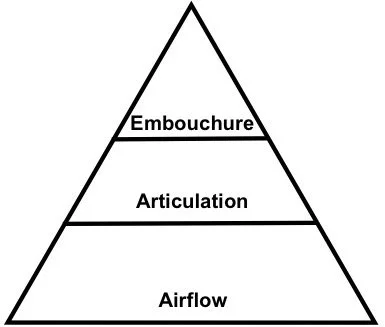
The Airflow is the motor; its job is to provide a stable, continuous energy source to the lips.
The Articulation is the trigger; it controls the initiation of the tone and clears the airway by releasing the tongue down and back away from the teeth.
The Embouchure is the vibrator; it transforms the kinetic energy of the airflow into sound, controlling pitch by varying the size of the aperture.
The Airflow
The first step of applying Burba’s principle is to ensure that the airflow remains even. Even airflow creates even vibrations, whereas uneven airflow creates uneven vibrations. Achieving a consistent airstream requires uniting three aspects into one fluid action: breathing, the air passage and momentum.
I have found teaching diaphragmatic breathing directly through anatomical cues to be largely ineffective, as the respiratory muscles possess very limited sensory receptors. Arnold Jacobs therefore encouraged students to “breathe at the lips”, shifting focus to where the movement of air can actually be felt (Steenstrup, 2007).
Efficient breathing involves inhalation through the contraction of the diaphragm and exhalation through the release of that contraction. Excess muscular tension during either phase disrupts the evenness of the airflow (Steenstrup, 2007). The initial energy for exhalation comes primarily from the relaxation and passive elastic recoil of the diaphragm. As lung capacity decreases, the abdominal muscles begin to contract increasingly in proportion to the decreasing lung volume until roughly 40% of full lung capacity, at which point exhalation depends solely on the abdominal muscles (Steenstrup, 2007). Consequently, the player should begin each phrase with a near full breath and breathe regularly to minimise unnecessary abdominal tension. Many brass players misinterpret this abdominal tension as “support”; however, it is simply a compensatory reaction to a resistance (Burba, 1997).
While playing in the normal range of the instrument and until the aperture becomes smaller than the mouthpiece bore, perceived resistance should not exceed the natural resistance of the instrument, that is, the resistance felt when simply blowing air through the instrument without producing a sound. Any resistance greater than this can only originate from a narrow air passage within the mouth, assuming a functional embouchure, restricting airflow to the lips.
An efficient air passage requires an open oral cavity which can be controlled by reproducing the “O” vowel shape. Although vowel shapes and the resulting tongue arch naturally shift with pitch, I have found the greatest success by consistently maintaining an “O” position, allowing the tongue to arch involuntarily as the pitch changes. As Burba notes, “The fewer changes there are in a system, the stabler the system” (Burba, 1997, p. 17), and this approach encourages only the adjustments strictly necessary.
A similar problem arises when a player attempts to follow the direction of the pitch with the air. Many students subconsciously try to control the pitch of the instrument by altering the direction or “pitch” of the airstream. Pitch, however, is determined solely by the frequency of lip vibrations (Burba, 1997). Angling the airstream up or down introduces unnecessary changes to the tongue position, narrowing the air passage and ultimately restricting airflow to the lips. The airstream has only one direction: straight ahead towards the back of the room. Keep in mind the teaching of James Stamp, “think down as you play up, and up as you play down” (Stamp, 2005, p. 4) to compensate for this and to keep the airflow straight.
Momentum refers to the continuation of the energy through the entire phrase. As established earlier, inhalation is the active muscular contraction and serves as the source of this energy. This energy must carry through to the final sound of a phrase with consistent airspeed and evenness for the musical phrase to sound uniform; much as a spoken sentence must be delivered in a single unbroken arch to be convincing.
Momentum is easily lost through breaks or hesitations in the airflow, whether at the turnaround between inhalation and exhalation or in the space between notes. As Steenstrup notes, “Exhalation is a natural consequence of the inhalation” (Steenstrup, 2007, p. 150), meaning the air column should rebound smoothly without holding or locking at the top of the breath. Hesitation at the start of a phrase can be eliminated by breathing in tempo. When the player inhales in time, the body internalises the pulse and anticipates the exact moment the sound must begin. Depending on the tempo, inhaling energetically one beat prior to the entrance and triggering the exhalation with a confident articulation removes any gap in the airstream.
It is also common for students to reduce the airspeed or stop the airflow altogether between notes, particularly when presented with larger intervals. To prevent any loss of momentum during these transitions, the player must ensure that the air is flowing actively towards the next note.
The Articulation
The articulation serves to unify all parts of the playing system, triggering them simultaneously to produce the tone (Farkas, 1962). I like to think of hitting a tennis ball: the backstroke represents the inhalation, and the articulation point serves as the racket’s contact with the ball. Just as in tennis, that contact must be timed with absolute precision for maximum efficiency.
The tongue must make contact behind the upper teeth (Farkas, 1962); if the tongue protrudes too far forward between the lips or teeth, it acts as a bottle cork, blocking the airway. Even if it is eventually released correctly, the tone will not begin cleanly because the airflow will release unevenly. Think of pulling a bath plug - the initial release is leakage around the broken seal and lacks the clean release of a sudden opening. The articulation is properly initiated by retracting the tongue down and back, instantly opening the airway. The speed of this retraction determines the clarity of the attack (Farkas, 1962).
This mechanism is best taught through speech. The student should think “tOh" into the instrument, placing heavy emphasis on the open vowel so the tongue quickly clears the air passage (Steenstrup, 2007). The following real-time MRI images demonstrate the correct tongue position at the moment of contact and immediately after retraction:
Figure 2
Real-Time MRI of Tongue Position Before (Left) and After (Right) Articulation Release
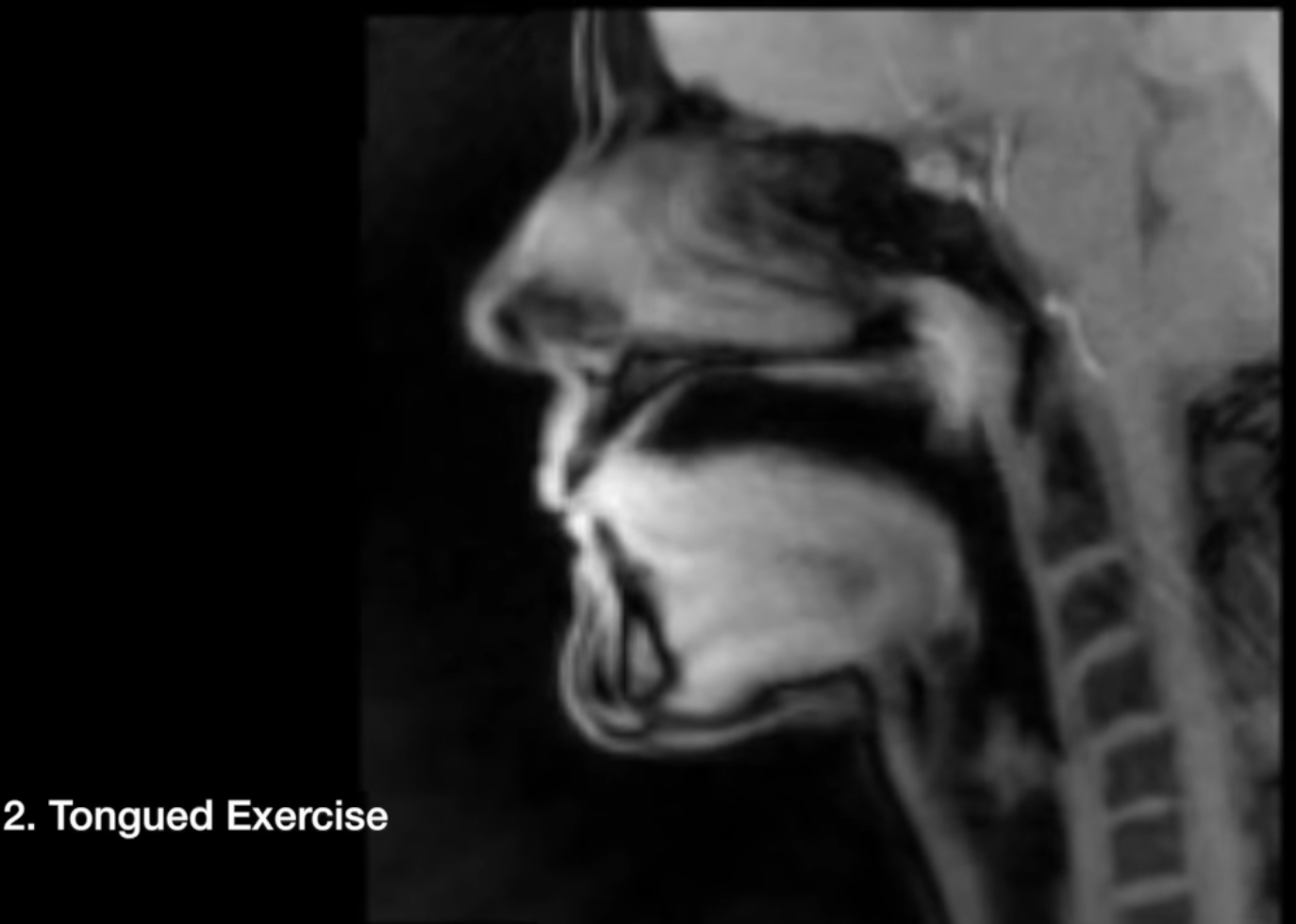
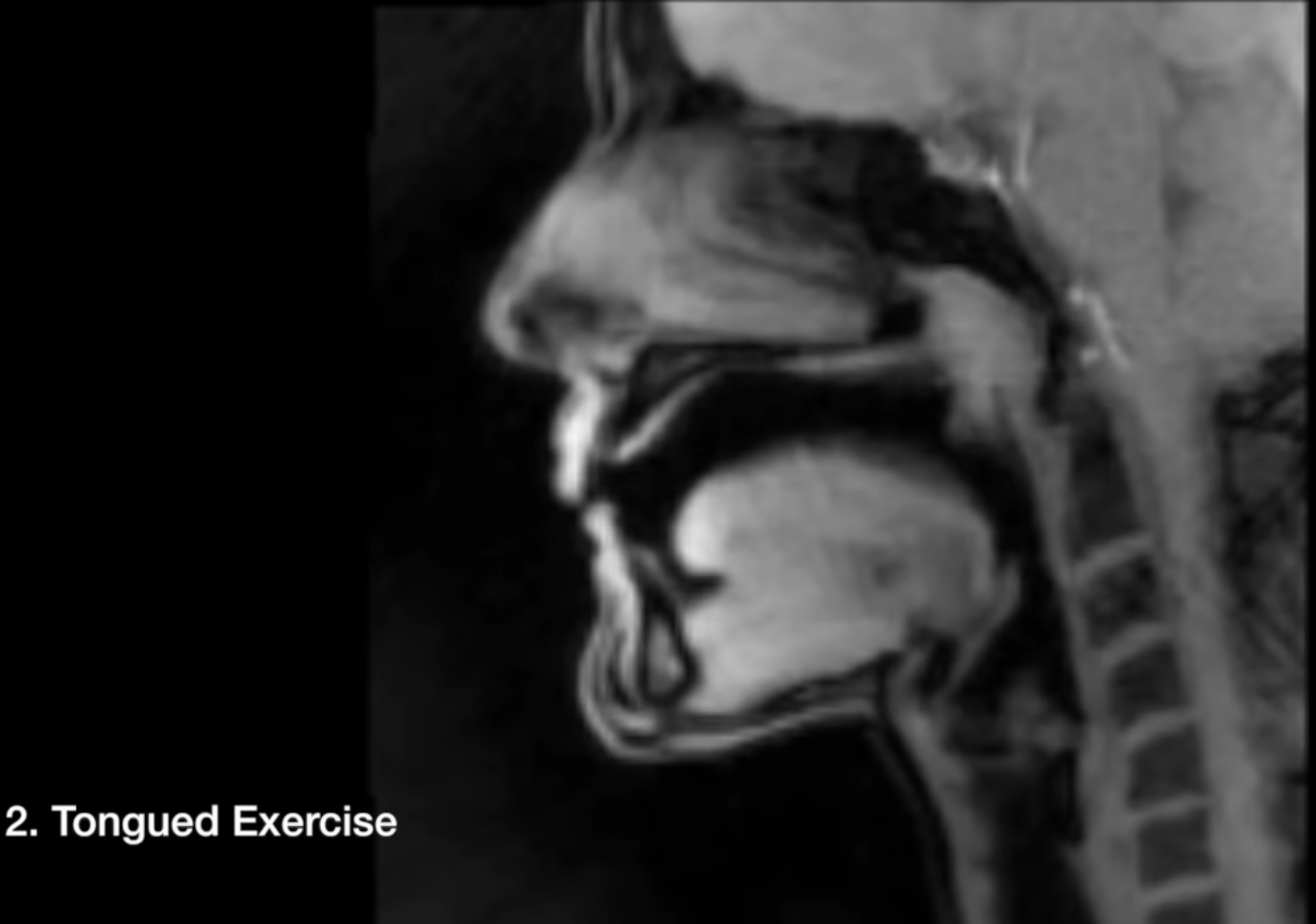
Note. Adapted from (MRI) Chamber Music with Sarah Willis [Video], by S. Willis, 2015. Real-time MRI footage courtesy of the Max Planck Institute for Biophysical Chemistry.
The Embouchure
Only once the airflow is efficient and the airway clear can the embouchure successfully convert air into a stable vibration. The embouchure is a muscular framework to provide a reliable anchor for stable vibrations. While some traditional methods advocate pulling the corners back rigidly like a violin string, the core mechanics rely on a balance of opposing forces: the cheek and corner muscles establish a stable baseline, while the orbicularis oris (the ring of muscles around the lips, activated as if whistling) draws inward toward the mouthpiece to form and control the aperture (Farkas, 1962). These ring muscles are directly responsible for managing pitch by opening and closing the aperture size. To develop this specific aperture control, I have found The Buzzing Book by James Thompson an invaluable method, supplemented by the lip flexibility exercises of Bai Lin, Earl D. Irons, and Charles Colin.
The placement of the mouthpiece is another crucial factor determining the quality of the resulting vibrations. If the mouthpiece is placed incorrectly or if the aperture is too outwardly spread, the rim can pin the firmer vermilion border (where the “red” meets the “white" area of the lips). Engaging this firmer tissue is essential because it is backed directly by the ring muscles, allowing for precise pitch manipulation. As a foundational rule for placement, the inner edge of the mouthpiece rim must remain within the white area of the lips at the highest and lowest point (Burba, 1997).
Despite these mechanical realities, many pedagogues advocate using the tongue arch as the primary mechanism for pitch control. Burba states, "Our thumb held on the front of the water hose is like our second outlet, the tongue, and regulates the pressure, i.e. the pitch" (Burba, 1997, p. 19). I believe there is a fundamental flaw in this logic: the thumb at the end of the hose actually functions as the aperture, opening and tightening to control the pitch. If we instead represent the tongue arch with our other hand squeezing the hose behind our thumb in an attempt to additionally accelerate the water speed, the overall result is that back pressure behind the thumb is reduced, and the water speed exiting the end is actually decreased. Therefore, as I mentioned above, the tongue should remain in the most open position possible and the aperture should take main responsibility for pitch control.
Conclusion
With this, we return to Burba’s fundamental concept from the opening of this essay: “When air is transformed evenly into vibrations, we get a clear tone” (Burba, 1997, p. 6). The three-tier pyramid serves as a diagnostic tool to identify the exact areas of inefficiency within the playing system. Too often, inefficiencies in the airflow are misdiagnosed as problems of the embouchure, and those of articulation misdiagnosed as problems of the airflow. As Steenstrup observes, “The trumpet player feels the fatigue at the embouchure, and most often blames the problem on the lips, even though they are merely reacting to the bad respiratory and aerodynamic conditions” (Steenstrup, 2007, p. 100). This highlights the vital importance of developing brass technique from the base of the pyramid upward, ensuring that airflow is efficient and the airway is clear before addressing the embouchure. Excessive mouthpiece pressure is no exception to this rule, being almost exclusively a symptom of inefficiency elsewhere in the playing system (Steenstrup, 2007).
Though the brass playing system will always remain invisible, its mechanics no longer have to be a mystery. When the air is evenly transformed into vibrations, we are liberated from technical thought and can apply Jacobs’ “Song and Wind” concept to the fullest extent. This is the moment we become artists.
-
Burba, M. (1997). Brass masterclass: Method for brass players. Schott Music.
Colin, C. (1980). Advanced lip flexibilities – Complete. Charles Colin Publications.
Farkas, P. (1962). The art of brass playing. Wind Music.
Irons, E. D. (1952). Twenty-seven groups of exercises for cornet or trumpet. Southern Music.
Lin, B. (1996). Lip flexibilities for all brass instruments. Balquhidder Music.
Nelson, B. (Comp.). (2006). Also sprach Arnold Jacobs: A developmental guide for brass wind musicians. Polymnia Press.
Stamp, J. (2005). Warm-ups & studies for trumpet (9th ed.). Editions Bim.
Steenstrup, K. (2007). Teaching brass (2nd ed.). The Royal Academy of Music, Aarhus.
Thompson, J. (2001). The buzzing book. Editions Bim.
Willis, S. [Sarah Willis]. (2015, May 20). (MRI) chamber music with Sarah Willis [Video]. YouTube. https://www.youtube.com/watch?v=MWcO722274A
The Artist as a Socio-Political Pedagogue
By Christian Sharpe | Published November 2026
Art is the organised product of a person’s experience interacting with the world around them (Dewey, 2005). Because human experience lies at its core, it possesses qualities that offer a perfect framework for socio-political education in society.
For John Dewey, this interaction with the environment makes art an inherently social activity (Dewey, 2005). Creating art consists of several layers of social interaction beyond the obvious collaborative act of making art with other people, with Dewey’s framework being the first. Our emotions and experiences are formed by our interactions with other humans and the nature around us. Processing these into a work of art forces us to reflect on them, fostering personal social development. Furthermore, by interacting with the art and experiences of others in the act of art consumption, we learn that our own experiences are shared by others. Interacting with art from other milieus opens the possibility for us to apprehend and integrate unfamiliar experiences with our own, through which "barriers are dissolved and limiting prejudices melt away” (Dewey, 2005, p. 348). By developing this cultural awareness, art forms the sympathetic base for our democratic society.
Art is a uniquely potent medium for cultural education across distant milieus, as it provides a universal mode of communication transcending the possibilities of speech. Dewey states, ”The differences between English, French and German speech create barriers that are submerged when art speaks” (Dewey, 2005, p. 349). It is precisely this quality that makes art an essential communicative tool for diplomacy between disparate groups, whether cultural, socio-economic or political. Furthermore, provides the framework for moral and socio-political ideals to be expressed through shared experiences, forging deeper sympathetic understanding among groups. As Dewey observes, "Hence it is that art is more moral than the moralities. For the latter either are or tend to become, consecrations of the status quo..." (Dewey, 2005, p. 362).
By bringing art down from the pedestal that is the art gallery or formal concert hall and returning it to the everyday experiences of society, art ceases to be “…the possession of the few who are recognized writers, painters, musicians; it is the authentic expression of any and all individuality” (Dewey, 1940/1988, p. 114). As artists who process and express our own experiences and emotions professionally, we occupy a unique position to promote the arts in these ways on a grassroots level within the community, ultimately empowering society through sympathy.
-
Dewey, J. (2005). Art as experience. Perennial Classics. (Original work published 1934)
Dewey, J. (1988). Time and individuality. In J. A. Boydston (Ed.), John Dewey: The later works, 1925–1953 (Vol. 14, pp. 98-114). Southern Illinois University Press.